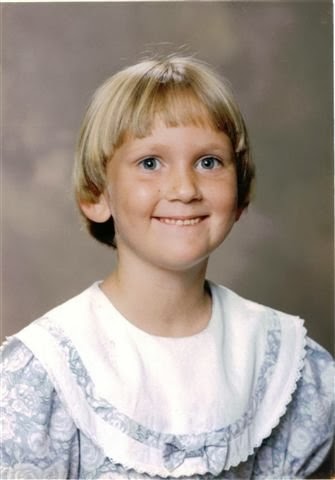
 On this day twenty years ago, life as I knew it changed forever. My seven year old daughter Bethany took her last breath and left this world much too soon. Over the years, I have grieved hard and long. I have longed for one more moment, one more day, one more opportunity to hold her in my arms and tell her I love her.
 Bethany's death is woven through the fabric of my life. While the grief has lessened with each passing year, the scar on my heart remains. I am and always will be the mother of a child who died. Those who have had a child to die have a keen understanding of the depth of the loss, pain and sorrow.
On this "death day" anniversary, I want to honor Bethany's memory by sharing some of the things I have learned over these twenty years. Her death taught me many lessons about life, love, forgiveness, perseverance, joy and gratitude. I want others to know something of the experience following the death of a child. So, here I share seven lessons for Bethany's seven years of life.
1. Parents who experience the death of a child don't "get over" the grief and they will never get over the death of their child. There is no timetable as we "get through" our grief. Our grief is prolonged because having a child die before you is so out of the natural order of things. Children should outlive their parents! We are left with painful reminders of lost promise and potential. We are left to grieve every event or milestone our child will miss, such as celebrating birthdays, holidays and holy days, another year of school, becoming a teenager, getting a driver's license, graduation, college, choosing a career, falling in love, getting married and having children. All those hopes and dreams for my child were buried with her.
2. Grief is a lonely journey. In the early days of my grief, I sometimes felt so alone, even when surrounded by a crowd of people. Oftentimes friends and family members didn't know what to say or do. Some chose to stay away because they just couldn't handle the grief or they were frightened by it. I understand how they could feel that way and I've never been angered by their absence. I am forever grateful to the friends and family members who have persevered with me for the long haul and have never attempted to explain away my grief. Their presence, patience and compassion continues to sustain me today.
3. I've learned that I can do hard things. Seeing my child in a casket and putting her body in the cold, hard ground on that January day is the hardest thing I have ever done. I can't imagine that I will ever do another thing in this life that will ever compare to burying my child. I've done the hardest thing a parent will ever have to do. I can get through anything now.
4. I am a strong woman. I've had more than my share of grief in my 56 years of life. After Bethany's death, I spent quite a bit of time wondering if I would ever return to the land of the living. I can remember watching the world go by and wondering why everyone and everything just didn't' stop on the day Bethany died. Didn't they know my world stopped that day? I plunged into the depths of depression, finding it difficult to get out of bed and put one foot in front of the other. With time, I found my way back to hope and healing. I have found a deep reservoir of strength and courage for the facing of each new sunrise.
5. I have learned to be patient, kind and compassionate to all persons. I try to remind myself of this daily as I seek to live by a quote attributed to Plato: "Be kind, for everyone you meet is fighting a hard battle." My own loss and grief has made me more sensitive to the trials, hardships, and burdens that others carry on their shoulders and in their hearts. We just never know what people are carrying around with them each day.
6. Forgiveness made all the difference in my journey through grief. On the day Bethany died, I never considered or had the desire to forgive the drunk driver who killed her. I hated him and I hated what he had done to her and the change he brought to my life. I had horrible thoughts about him and I wished him harm. With time, I did make my way to a place of offering forgiveness to him. To this day, I do not harbor any ill feelings, anger or malice towards him. I chose not to be a victim of his actions. The choice to forgive him was life-giving. It was the way I got my life back.
7. My faith has found a resting place. Through Bethany's death, I've learned that I don't have all the answers to my many questions about God, theology, life and death. There is mystery, and in the mystery, there is faith and hope. There was a time when I had many questions for God, such as "Why didn't God intervene and save Bethany?" "Where were you God?" "Why didn't God give me a miracle?" I've come to believe that one day all my questions won't matter. When I'm reunited with Bethany in heaven, there will no longer be a need to ask my questions.
Bethany was my miracle on the day she was born. Today and every day, I choose to celebrate her life. I choose to remember not what I lost as a result of Bethany's death, but to remember how blessed I was to have her for seven short years. I will miss her until the day I die.